Previously, we explored theoretically how Activity Based Costing (ABC) can provide more accurate cost tracking, which in turn allows for monetary and efficiency benefits. Through this illustrative example, we are going to put the theory into practice putting Quantity-Based costing against Activity Based Costing.
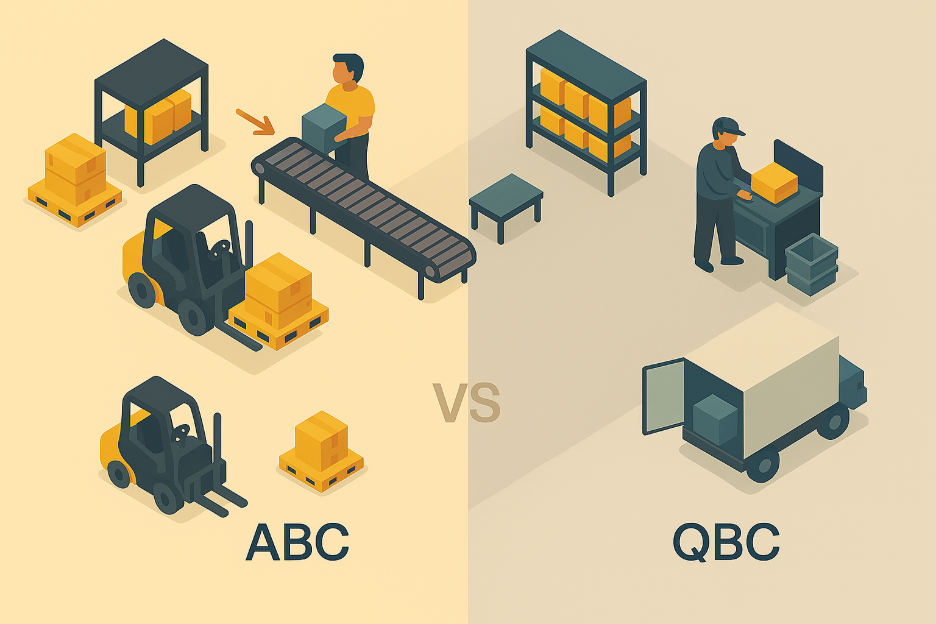
Future Logistics is a third-party logistics provider. Their customer New Electronics is a fast-growing electronics retailer that stores and distributes their product through Future Logistics' warehouse. At this warehouse, Future Logistics handles 3 specific types of products: Palletized Large Appliances, Case-Pick Medium Electronics, and Each-Pick Handhelds.
While all three product types move through the same warehouse, they consume operational effort in very different ways. Despite these clear differences, Future Logistics has always allocated warehouse operating costs using Quantity-Based Costing, spreading costs based on units shipped. In order to evaluate true cost-to-serve, New Electronics conducted an Activity-Based Costing analysis.
Read the story
Palletized appliances like refrigerators or washing machines have longer dock occupancy and require a forklift, but usually require minimal packing. Medium electronics like ovens and blenders move through conveyor belts. And lastly, Each-pick handheld devices require safe storage, serial number tracking and intensive pick-and-pack labor.
Despite these clear differences, Future Logistics has always allocated warehouse operating costs using Quantity-Based Costing, spreading costs based on units shipped. In order to evaluate true cost-to-serve, New Electronics conducted an Activity-Based Costing analysis, assigning costs to actual warehouse activities performed: Unload, Putaway, Pick, Pack and Load.
| Row / Product Type | Palletised Large Appliances (PL) | Case-Pick Medium Electronics (CM) | Each-Pick Handhelds (EH) |
|---|---|---|---|
| Revenue | €24,000,000 | €32,000,000 | €78,000,000 |
| COGS | €18,500,000 | €23,800,000 | €59,800,000 |
| Allocated OpEx (QBC) | €156,600 | €1,827,000 | €5,215,200 |
| Net Profit | €5,343,400 | €6,373,000 | €12,984,800 |
| Margin % | 22.3% | 19.9% | 16.6% |
| Row / Product Type | Palletised Large Appliances (PL) | Case-Pick Medium Electronics (CM) | Each-Pick Handhelds (EH) |
|---|---|---|---|
| Revenue | €24,000,000 | €32,000,000 | €78,000,000 |
| COGS | €18,500,000 | €23,800,000 | €59,800,000 |
| Unload | €715,385 | €473,077 | €311,538 |
| Putaway | €26,087 | €303,130 | €870,783 |
| Pick | €329,508 | €384,000 | €2,086,492 |
| Pack | €27,865 | €222,746 | €849,389 |
| Load | €319,424 | €168,671 | €112,903 |
| Total OpEx (ABC) | €1,418,269 | €1,551,624 | €4,230,105 |
| Net Profit | €4,081,731 | €6,648,376 | €13,969,895 |
| Margin % | 17.0% | 20.8% | 17.9% |
Palletized Large Appliances have higher true costs as they require far more unloading, staging and forklift handling than QBC assumes. Since Case-Pick Medium Electronics are more balanced in terms of operational effort, QBC's assumptions are fairly accurate. Intensive pick-and-pack labor and security handling required by Handhelds leads to inflated profitability estimates by QBC. ABC corrects these inaccuracies by assigning costs to the specific activities performed for each product type.
Activity-Based Costing reflects the actual operational effort behind each product type by assigning costs to the activities that consume resources, providing a more accurate and transparent view of cost-to-serve. In contrast, Quantity-Based Costing spreads expenses evenly across units regardless of complexity, leading to misleading profitability results. ABC offers modern warehouses and retailers the precision needed for informed decision-making and fair cost allocation.